


 Before writing about Lelo, we must recall a specific detail from the so-called "Crimean War" (1853–1856) between the Russian and Ottoman Empires. In the summer of 1854, one sector of this war's frontline in Georgia ran along the Choloki River. Hasan Beg Tavdgiridze served as the Beylerbey of the Kobuleti Vilayet, which was then under the protectorate of the Ottoman Empire. Originally a native of the village of Aketi in the Guria Uyezd (now Lanchkhuti District), his family had moved to Kobuleti during his childhood, presumably due to a blood feud.
Young Hasan embraced Islam, studying first in a local mosque and later at a madrasa in Trabzon. His innate talent and courageous nature eventually propelled him to the rank of Beylerbey of Kobuleti. According to oral tradition, Hasan Beg maintained good relations with the Gurian peasantry. However, following the outbreak of the war, as both an Ottoman subject and an imperial official, he proposed that the Gurians sever their ties with Russia and fight on Turkey's side. The Gurians firmly refused.
Hasan Beg Tavdgiridze subsequently invaded Guria with his 9,000-man army, comprised mostly of Islamized Georgians and Turkish askars (soldiers). He crossed the Choloki River near the village of Shekvetili, fought his way through the Aketi-Mamati territory, and launched an assault on the palace of the Machutadze princes in the village of Nigoiti from the mountain side. Hasan Beg sent a message ahead, declaring: "Bring out as many men as you can muster, and I shall fight them all."
Historical records show that General Andronikashvili, commander of the Russian Imperial forces, had around 12,000 troops at his disposal. However, in the battle near Shukhutperdi—a pivotal engagement of the Nigoiti War—the Georgian side was represented by a battalion of 2,000 Russian Cossacks and 625 Gurian militiamen. The Gurians pushed Tavdgiridze’s army back toward Lanchkhuti. The main clash of this battle took place in the center of what is now the village of Shukhuti, near the so-called "Linden Trees"—an event etched into history as the Battle of Shukhutperdi. According to local lore, Tavdgiridze’s warriors who fell in that battle are buried beneath these linden trees.
History describes the battle as follows: the Gurians threw Tavdgiridze’s forces back across the Supsa River entirely by pushing and driving them out like a Lelo. Hasan Beg Tavdgiridze himself perished in this battle. "The nobleman Erasti Chkhonia rushed at Hasan Beg on horseback and severed his head with a single stroke of his sword. He struck with such force that the head flew to one side of the horse, and the body fell to the other." Records indicate that more than 5,000 soldiers from Tavdgiridze’s army were killed, wounded, or captured, while the victorious side lost only about six hundred men, most of whom were soldiers of the Russian battalion.
According to tradition, the fallen Hasan Beg was buried with great honor by his first cousin and battlefield adversary, Karaman Tavdgiridze (commander of the Gurian Aketi detachment), alongside Gurian horsemen and defeated soldiers of Guria origin who shared the Muslim faith. In memory of these events, the people first composed a poem, which later evolved into a masterpiece of Georgian folklore: the song "Hasanbegura." It is said to have been sung first by the Gurian inhabitants of the village of Kakhuti in the Ozurgeti district.
There are 19 known variations of "Hasanbegura." The text of one version reads:
"Hasan Beg Tavdgiridze, forsaken by God, Earned the title of a Turkish Pasha and forgot the Lord entirely, He entered Shekvetili, shouting 'Olan Geti!' We, the militia, were on the road, with very few Russian troops, An army of nine thousand Turks confronted us with malice. As he entered Lanchkhuti, the battle raged at Shukhutperdi, They fled and scattered, their ranks broken in panic, Out of nine thousand Turkish troops, barely five hundred escaped dry. I saw my brother, Hasan Pasha, decapitated, I cried out in grief, yet he was my brother, And in the end, it was I who buried him."
The poem directly implies that it is narrated through the voice of Karaman Tavdgiridze, Hasan Beg’s first cousin.
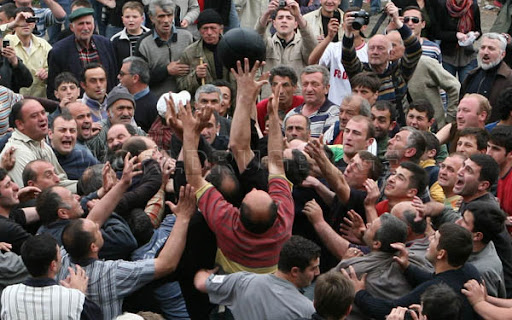
Now, let us describe the game of Lelo. Lelo is an ancient Georgian word that means "to carry through by force." The rules of Shukhuti's Lelo are as follows: the ball weighs exactly one pood (16 kg). Its leather casing is filled with sand and sawdust. In olden times, before the ball was stitched completely shut, the juice of Aguna was poured into it on the eve of Easter. Aguna is a Christianized wine ritual originating from an ancient pagan celebration (akin to the cults of Harale, Dionysus, and Bacchus) that is now largely forgotten. Aguna is a blend of dark wine, honey, pomegranate juice, and other components whose exact recipe remains unknown. The players were also given a single sip of it. This mixture was believed to instill immense strength and courage; Gurian warriors used to carry this liquid into battle and would always drink it before a fight.
Two small streams flow 200 meters apart on either side of the village center—presumably the exact site where the decisive clash of Shukhutperdi began. On one side runs the Sachinkie stream, and on the other, the Ukan stream (also known as the Black stream). Consider the parallel: Tavdgiridze’s objective was to push the Gurian horsemen beyond the Rioni River, while the Gurians aimed to drive Tavdgiridze beyond the Supsa River. The 16-kilogram Lelo ball itself symbolizes the sheer weight of battle.
At the same time, ball games as public festivals are among the oldest and most widespread traditions in human history, often serving as elements of military training—from the Maasai tribes of Africa to the Aztec indigenous people of Mexico. In pagan history, the ball generally represents the sun, and it was played in Shukhuti just as it was in many other parts of Georgia. Therefore, the core principle of Shukhuti’s Lelo did not appear suddenly out of nowhere; it had deep historical roots.
In modern Shukhuti Lelo, however, the ball serves a purpose beyond representing the sun. According to tradition, when Erasti Chkhonia decapitated Hasan Beg, he grabbed him by the hair, held his head high, and showed it to the enemy to signal that their commander was dead. His intent was to break the enemy's psychological resolve. However, the opposing forces revered their commander so deeply that the subsequent clash was fought not for victory or defeat, but for possession of their leader's head.
If we examine the human anatomy, the head weighs approximately one-fifth of the entire body. With an average human weight of 80 kg, the head weighs around 16 kg—exactly one pood. Thus, the sacred manifestation of the Shukhuti Lelo ball, besides being a solar symbol, represents the severed head of Tavdgiridze, for which both sides contend. In this game, the number of players on either side does not matter; whoever musters the most collective strength wins. Contrast this with Tavdgiridze's message: "Bring out as many men as you can muster."
Lelo features only a single, chivalrous rule: if someone falls during the game, play stops immediately. "One does not strike a fallen man." The game unfolds precisely as the historical battle is described: "by pushing and driving the Lelo." The winner is the side that manages to carry the ball across their designated stream, along with their players. Consider the parallel: the goal of the battle was to force the opponent to the other side of the river.
The finale of the game—the prize of victory—is always the same. Both sides dedicate the match beforehand to the memory of a deceased young person or a highly respected individual. The winning team, accompanied by the defeated players, carries the ball to that person's grave. There, they raise a glass of wine to bless the soul of the departed, and this tribute is paid not only to the deceased to whom the ball was dedicated but to others as well. The game has never had any other conclusion, and there has never been an instance of a ball going missing from a grave.
Consider the ultimate parallel: in the Battle of Shukhutperdi, Georgians of the same blood and lineage, yet of different faiths, fought against one another. The victors mourned the defeated just as they would their own dead, committing them to the earth with the highest honors.
The identity of Shukhuti’s Lelo and its connection to the Battle of Shukhutperdi from nearly two centuries ago is unmistakable. The Lelo match played every Easter Sunday in the village of Shukhuti is a ritual commemorating this very battle. It functions much like the Khorumi dance—an ancient pre-battle warrior ritual. Just as the Khorumi mirrors the elements of combat, Lelo has, for nearly two centuries, replicated the ritual of the miraculous battle fought in its very heart.
Tamaz Imnaishvili
Resident of Shukhuti and Historian of its Past